Corona Impact

Update August 2020 – Impact analysis COVID-19 pandemic

The impact of the COVID-19 pandemic to the Additive Manufacturing market

The global outbreak of the COVID-19 virus led to a lockdown and travel ban in most industrialized countries. The market development of metal Additive Manufacturing in 2020 and the following years will be directly impacted. Much of the survey for the AMPOWER Report 2020 was conducted before the lockdown came into effect. Therefore, the forecast of the AMPOWER Report represents the industry’s view on the market development before the full scale of the pandemic was obvious. To provide additional insights, AMPOWER analyzes in this section the impact COVID-19 might have on the global metal Additive Manufacturing industry and will discuss potential scenarios on the future development of the market.

Corona impact additive manufacturing

Summary

Global effects of COVID-19

The COVID-19 pandemic continues to cast its shadow over the global economy. Months after the beginning of the pandemic, it is now becoming clear that the economy has suffered a significant slump as a result of the measures taken to contain and reduce the risk of infection, and will continue to be negatively affected in the near future.

  • The market for metal Additive Manufacturing in 2021 is expected to be -11 % to -39 % below previous expectations.

  • Equipment manufacturers and service providers in the field of 3D printing are predominantly posting double-digit percentage declines in revenues in the second quarter of 2020 compared to the previous year.

Quo vadis Additive Manufacturing

A short-term increase in demand for 3D printed components can be ruled out based on the previously presented financial data of AM companies. However, it is expected that the customers of such AM products and services will re-evaluate their sourcing and supply chain strategy in the medium to long term on the basis of the experience now gained. This reorientation of supply chains offers significant potential for Additive Manufacturing. The accompanying flexibility and availability can represent a considerable added value that has hardly or not at all been considered so far and may also justify a cost increase due to risk reduction.

However, changes in production processes cannot be made overnight. For successful Additive Manufacturing, the interaction of the design, the AM process, but also the post processing steps is essential to achieve a good result. The move from conventional manufacturing of products to AM requires therefore development effort and additional resources for implementation.

3D printing in the pandemic

Severe economy impact from disruption of trade routes

Not only public life, but also industrial production came to a standstill in many places. As a consequence of the disrupted trade routes many areas revealed a high degree of dependence. Due to the outsourcing of production steps to distant low-wage countries and the procurement of raw materials as well as semi-finished products from these countries, accessibility was no longer guaranteed.

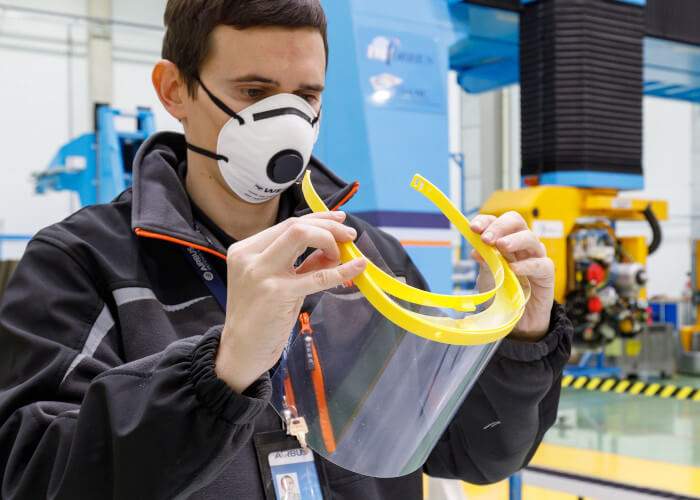
The topic of 3D printing has consequently received a great deal of attention in the media as its advantages of decentralized and short process chains became important. For example, success stories about the printing of components for face masks and ventilators were omnipresent. Other companies have commissioned components using 3D printing. Although this meant higher costs in production, it also ensured the delivery of some products to their customers.

Nevertheless, these published success stories are overall limited. For these aforementioned specific applications of medical technology, high requirements exist on product quality and production, such as traceability. The short-term replacement of high-quality and elaborately developed, tested and ultimately approved products is not feasible. Questions of safety and compatibility of the materials, but also of liability, have to be answered beforehand in order to establish new 3D printing production routes for such components. At present, Additive Manufacturing can therefore only contribute to a rapid alleviation of the situation in emergencies where stock is depleted and other measures are not available.

While 3D printing produced a positive overall picture in the rapid disaster relief scenario, Additive Manufacturing in the industrial environment suffers greatly from the slump in the overall economy. Today’s largest industry for metal additive manufacturing, aerospace, came to an abrupt shutdown in the area of passenger transportation. The need to cut costs led to the discontinuation of research and development activities, which included 3D printing projects. Furthermore, it is becoming apparent that the recovery will be tough and protracted. Other important industries for 3D printing will also be affected by the increasing reluctance of consumers, such as the automotive industry.

The extent to which Additive Manufacturing in Europe will benefit disproportionately from the crisis depends to a large extent on the courage and investment will of the large OEMs. The weaknesses in international supply chains and manufacturing in low-wage countries revealed by the crisis must be followed by an active relocation and modification of manufacturing using Additive Manufacturing. However, this requires considerable investment not only in AM machine technology, but also in development capacity for AM-compatible designs and upstream and downstream processes.

Global market forecast by IMF

General development of the economy

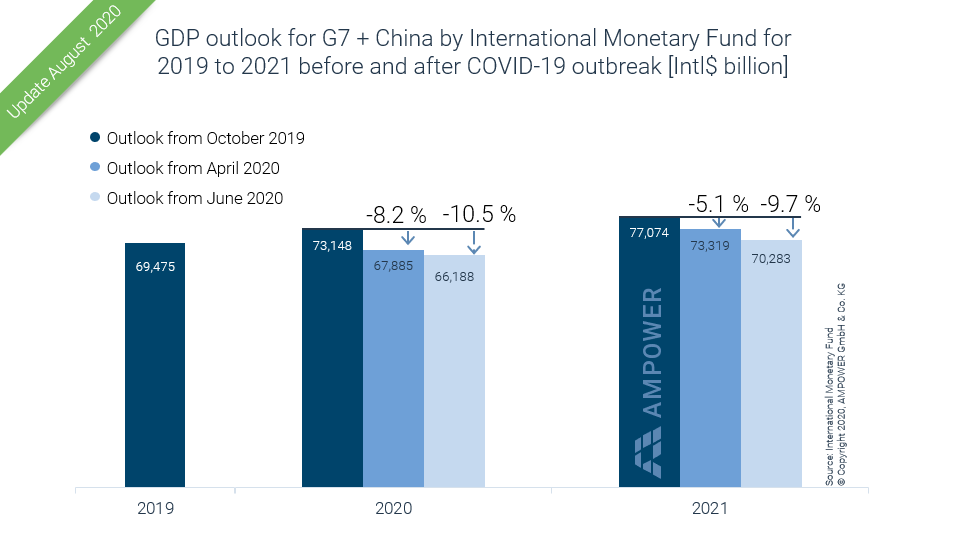
The forecasts of the International Monetary Fund (IMF) provide information on the future development of global markets. In April 2020, the IMF published an initial estimate of the impact of the COVID-19 pandemic. It predicted a reduction in gross domestic product (GDP) of over ‑8% for the most important countries, based on estimates from the period before the pandemic.

The overall economic outlook has continued to deteriorate since then. The expected easing did not occur or occurred more slowly than projected. In June 2020, the IMF updated its forecast for the expected gross domestic products of the G7 countries and China and lowered it by further percentage points. The IMF predicts that, in 2021, the GDP of these countries will be roughly at the same level as in 2019.

Global impact for 2020 and 2021 market forecast

Two scenarios between reduced growth and lost year

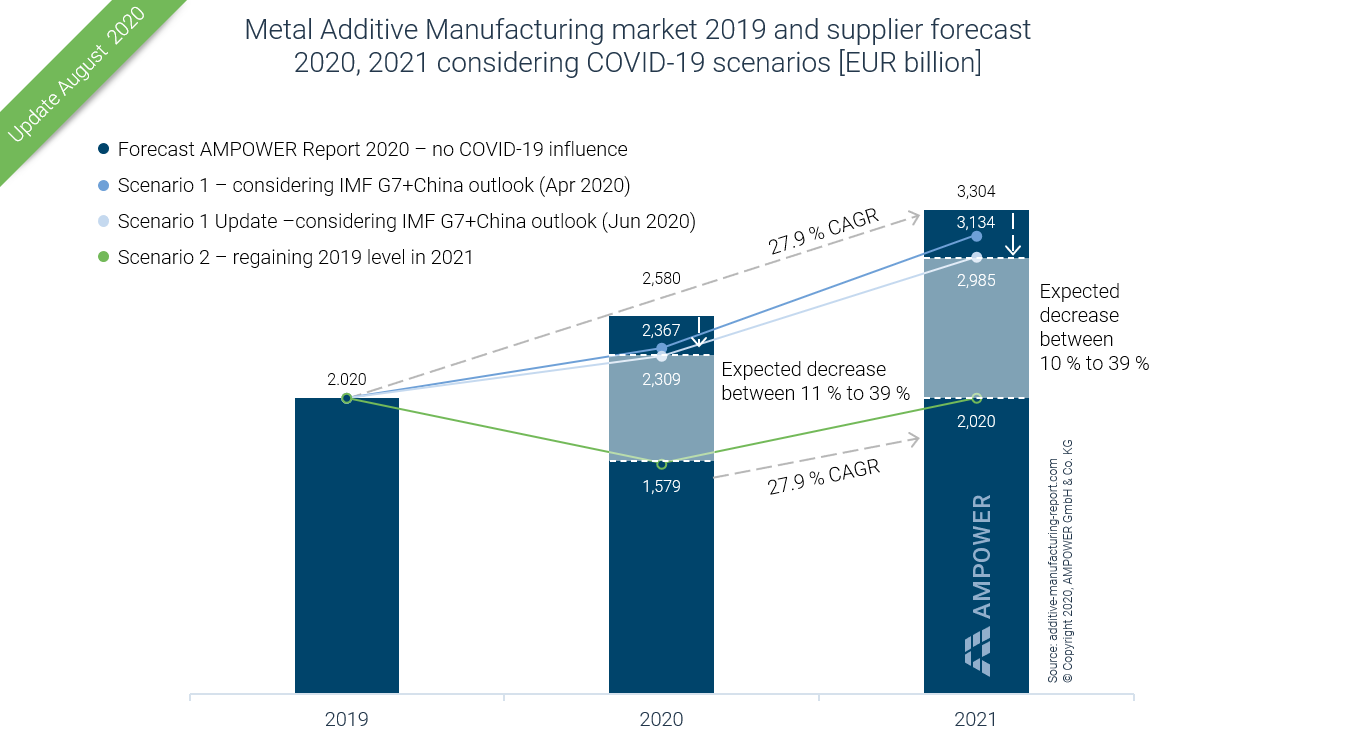
The market for metal Additive Manufacturing had a volume of EUR 2.02 billion in 2019. Before the onset of the crisis, market participants predicted annual growth of 27.9 %, so that a market volume of EUR 2.58 billion and EUR 3.30 billion was expected for 2020 and 2021, respectively. In order to assess the impact of the COVID-19 pandemic on this market, the management consultancy AMPOWER published an analysis in May 2020, which is updated below based on the new assumptions of the IMF.

Scenario 1 - Reduced Growth

In the first scenario, the expected development of the market for metal Additive Manufacturing takes into account the overall economic development. This scenario is mainly based on the forecasts of the IMF and the prediction of the market growth by AMPOWER. After the first analysis by the IMF in April 2020, the assumptions were updated in June 2020. According to this update, the GDP will decline more strongly than previously assumed.

Compared to the previous expectation, the metal 3D printing market will grow much more slowly. Compared to the predicted market volume before COVID-19, scenario 1 yields for the years 2020 and 2021 a reduction of the total market of approximately -11% and -10%, respectively. This reduces the annual market growth forecast for 2020 from 27.9 % to 14.3 %.

Scenario 2 - Regaining 2019 level in 2021

The second scenario is based on the assumption that growth in the AM sector comes to a complete standstill, a significant slump occurs and the market volume in 2021 is at the same level as in 2019. This would results in a -39% reduction of the expected market volume in 2021 compared to the predicted size.

Metal AM

System manufacturer for metal Additive Manufacturing

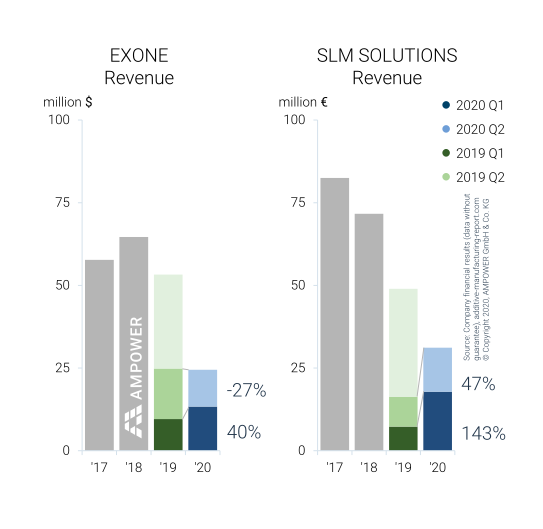
For metal AM, Binder Jetting system manufacturer EXONE reported a decline in 2019. After a positive first quarter in 2020, second quarter revenue fell to -27 % compared to the previous year. It should be noted that EXONE’s sales in the Products, Materials and Service division were relatively constant and for Q2 2020 even increased by 2 % compared to the previous year.

For SLM SOLUTIONS, a provider of Powder Bed Fusion machines, reported an increase in revenue in 2020, however, following a sharp decline in sales in the previous two years. After 143 % revenue growth in the first quarter, a 47 % increase in sales was achieved in the second quarter compared to the same period of the previous year. However, also SLM may not fully defy the crisis either and the impact could simply be delayed. For the first half of the year, a decline in orders of -34 % compared to the previous year was reported. A significant drop in demand from the civil aviation and oil and gas industry is also noted in the financial report.

Polymer AM

Equipment manufacturers polymer 3D printing

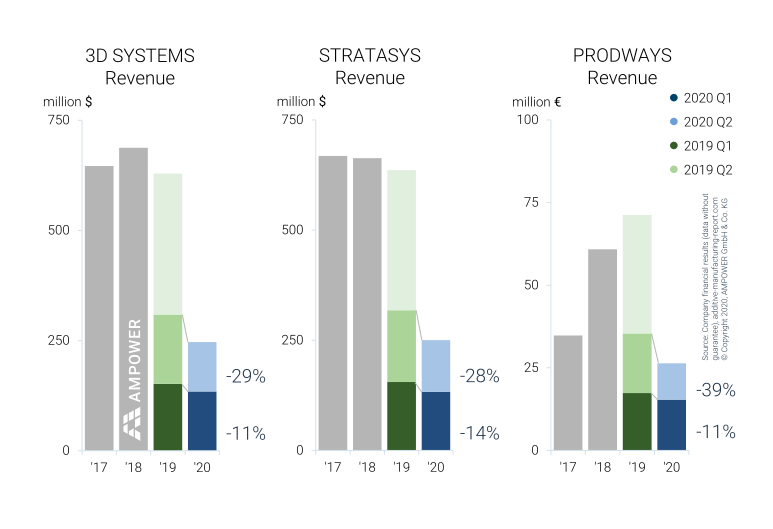
The equipment manufacturer 3D SYSTEMS, active in the polymer and metal sector, already suffered a decline in sales of -9 % from 2018 to 2019. In the first two quarters of this year, again reduced revenue was reported. In the second quarter of 2020, revenue fell by -29 % compared to the previous year. This slump is attributable in particular to lower printer sales, which fell by -43 % year-on-year. The lower sales of -30 % in the area of materials also indicate lower capacity utilization of printers by customers.

The system manufacturer STRATASYS, currently almost exclusively offering polymer machines and services on the market, presents a similar picture. Declining annual sales have been observed since 2017. Compared to the previous year, revenue in the second quarter of 2020 was down by -28 %. While services were down by -17 %, the decline was particularly noticeable in sold printers and consumables, which fell by more than -30 %.

PRODWAYS, on the other hand, has shown positive growth in the double-digit range in recent years with its polymer systems and other activities. However, revenue in the second quarter of 2020 was also down -39 % on the previous year, following an -11 % decline in Q1.

AMPOWER attributes the general decline in sales of established equipment manufacturers in recent years primarily to the increasing competitive pressure in the machine market. In the polymer machine market, the entry of HP and others has led to major shifts. In the metal system sector, the push of the Binder Jetting technology and the steadily increasing number of equipment manufacturers of Powder Bed Fusion technology has led to an oversupply of AM machines. A quick recovery of system sales in the polymer and metal market is not expected by AMPOWER due to the overall economic forecast. Rather, an accelerated consolidation of the numerous system manufacturers is inevitable in the following years.


AM service providers

Service bureaus during the crisis

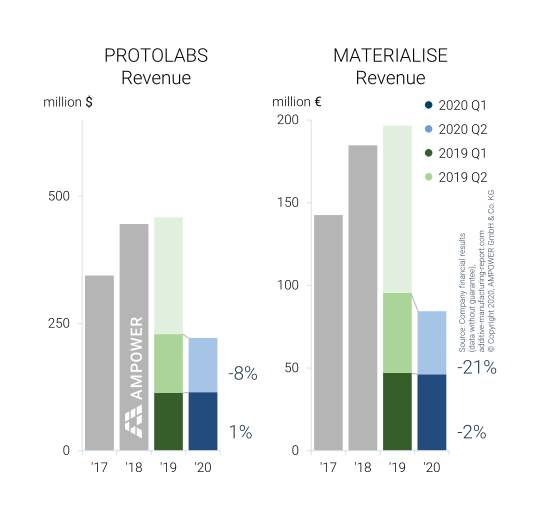
The steady increase of revenue in the past few years was followed by a stagnation or a decrease of turnover in the first half of this year for the AM service providers PROTOLABS and MATERIALISE.

The revenue of Additive Manufacturing division of service provider PROTOLABS fell only by about -7 % in the second quarter compared to the previous year. This is almost identical to the sales decline of the entire company of -8 %. For the first half of the year, this represents a moderate decline of -3 % compared to 2019.

By contrast, company MATERIALISE saw a steeper year-on-year decline in revenue of manufacturing services. In the second quarter of 2020, revenue in the medical technology area reduced by -19 %, for the other industries by ‑32 %.

It seems that the AM service providers were only directly affected once the lock-down and the reduction of economic activity occurred in Q2. AMPOWER expects that the slump in the overall economy will continue to affect the service providers and that the sales figures in Q3 and Q4 of 2020 will also be significantly lower than in the previous year.

Voices from Executive Management

Opinions from company leaders

“The ability and willingness of our clients to interact with us in this extraordinary time on new, complex projects also slowed as many were more inward focused as they tried to navigate the challenges brought on by COVID-19. …

At the same time, however, we have experienced an increased interest from current and new customers across the manufacturing space for our systems and technology as the COVID-19 pandemic focusses companies heavily on derisking their global supply chains, localizing key component manufacturing and creating increased flexibility in their manufacturing processes.”

(Excerpt SLM SOLUTIONS H1 Report 2020)

“With the continued spread of COVID-19 in many parts of the world and the increased disruption to the global economy, we expect the pandemic’s impact on our operations to be even more pronounced in the third quarter and to continue throughout the entire second half of the year.”

(Excerpt MATERIALISE Q2 2020 press release)

“3D Printing is penetrating further into manufacturing across every relevant business sector. In fact (…) we’re seeing businesses and governments reassessing their supply chain and implementing decisions that will drive increased demand for 3D Printing as a strategic imperative, leading to additional business opportunities for Stratasys. Localization and the need for increased self-sufficiency are both on the rise, among the many benefits that are creating a greater need for manufacturers to seek 3D Printing solutions.”

(Excerpt STRATASYS Q2 2020 earnings call)

Rainer Grünauer, Head of Additive Manufacturing sales at TRUMPF

From a technological point of view, the corona crisis is a great opportunity for metal Additive Manufacturing. Right now, many companies have the opportunity to deal with additive technologies and to find out whether they add value. However, it is difficult to make a forecast for the next fiscal year because we cannot predict the length of the corona epidemic. Nevertheless, we anticipate a slight increase in sales. We are launching two new systems worldwide – the TruPrint 2000, which is ideal for medical technology, and the TruPrint 5000 with many new automation functions. The systems address the sectors relevant to Additive Manufacturing, which is why we assume that there will be strong interest among customers.

One possibility for companies in the area of ​​Additive Manufacturing is to cooperate more closely with partners during the crisis. Many Additive Manufacturing providers are start-ups or smaller companies. They have the advantage that they are innovative and can react quickly and flexibly to new requirements. However, they often lack the financial scope to launch new products. Large companies, on the other hand, have more staying power in times of crisis. Cooperations could benefit everyone involved. That would be a great opportunity for the entire 3D printing industry.

Andreas Hartmann CEO/CTO Solukon Maschinenbau GmbH

AM offers exceptionally high potential for manufacturing in house. This means that capacities can be built up spontaneously and without major effort. AM is certainly still new as a production method and many processes are not yet ready to be implemented. But it is precisely with special applications that AM can show its advantages. Especially during the Corona crisis, this unique potential makes it possible to secure the supply chain for special parts or to cover the demand for completely new equipment. A great example was the rapid implementation of creative devices to support the ventilation of patients. The AM community proved to be extremely innovative and well connected. It has proven that it can adapt quickly to new requirements and can deliver both supply chain and quality. Innovation, technology and organisation worked in an exemplary manner and once again proved a respectable state of the art. It is hoped that many sectors of the industry, both large and medium sized, will see this as a proof of their ability to meet the demands of the market.

If you follow the news, many areas in which AM is already an established technology, such as Space, continue to work successfully.  AM requires less design and manufacturing effort than conventional methods. In most cases the development can take place completely in house. This means that external disturbances and crises have less impact on running projects. Parts of the industry with larger production figures and a more branched supplier network, such as the international automotive industry, have been more affected by a weakened supply chain.

If AM is to compensate for major interruptions in the supply chain in the future, capacities must be expanded and the automation of process chains must be advanced. Particular emphasis should be placed on post-processing. Especially the area of unpacking and powder removal at powder bed fusion processes offers enormous potential for process acceleration and replenishment through powder recovery. We believe that Solukon is ready to address current challenges and we will continue to develop our automated powder recovery systems to address future needs as well.

Carl Fruth, CEO FIT AG

We expect business to increase again in 2021. Both in prototyping and in the end use of components. On the one hand, we believe that the industry will develop innovative solutions again after the crisis, and on the other hand, we also think that a large number of companies will part with their own manufacturing capacities for cost reasons.

I cannot see any special branches of industry in which a particularly positive or negative influence will take place. It is always up to the individual company and the specific innovation strategy. However, a large number of companies that have developed a strategy for AM over the past two years are likely to face a variety of other challenges in their core businesses due to the corona crisis and put their activities in AM on hold.

Due to the overcapacity on the market created in the last 3 years and the associated very low market prices, many companies in the AM area will not be able to generate profits and will therefore disappear from the market in the course of 2020. Already 2019 was very challenging. In the 2018 balance sheets, you can see the low profitability of AM service suppliers (as far as these figures are listed for “mixed companies”).
In particular, I think the next one to two years will also be very challenging for the system manufacturers.
We ourselves consider whether we should invest in our own “AM products” in order to make ourselves more independent of our customers’ innovation strategies.

Ludovico Camarda, General Manager Coherent

Beside the obvious slowdown of sales activities, we have noticed occasional “bearish” behavior from our distributors, and some delayed orders.

I would signal a slight increase in service requests, as companies profit from the downtime to carry maintenance work to the equipment. To be successful in this crisis, I recommend: 1. Focus efforts on the products that bring the most of the revenue (80/20 rule). 2. Work on new marketing strategies and product offering that increase value to the customer. 3. Introduce new aggressive pricing campaign throughout the whole product range