Binder Jetting

Technology deep dive

Binder Jetting – Enabling high volume production

The patents for Binder Jetting are as old as the ones from Laser Beam Powder Bed Fusion. However, in recent years, the technology is getting more attention due to several new players in the field who claim, Binder Jetting might enable large volume metal Additive Manufacturing production. In this report section, you learn everything about the background and state of the art of this technology.

Courtesy of The ExOne Company

Technology principle

How does Binder Jetting work?

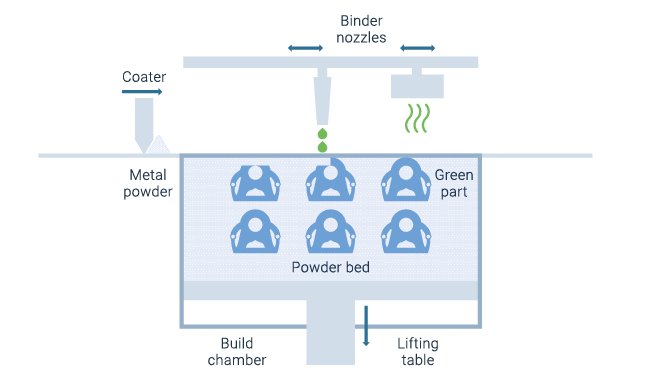
Binder Jetting is a powder based Additive Manufacturing technology in which a liquid polymer binder phase is selectively deposited onto the powder bed joining the metal particles and forming a green body.

The metal powder is applied to a build platform in a typical layer thickness of 50 µm to 75 µm. Subsequently a modified 2D print head ejects a binder liquid selectively into the powder bed. Depending on machine technology a hardening or curing process of the binder phase is performed in parallel for each layer and/or at the end of the whole build. During the in-situ curing process a heat source is used to solidify the binder and form a solid polymer – metal powder composite. Afterwards the build platform moves downward by the amount of one layer thickness and a new layer of powder is applied. Again, the liquid binder is deposited and hardened in the required regions of the next layer to form the green body. This process is repeated until the complete part is printed. After the complete printing process is finished the parts have to be removed from the “powder cake” meaning the surrounding loose but densified powder. To improve the removal of the excess powder from the green body often brushes or a blasting gun with air pressure are used.

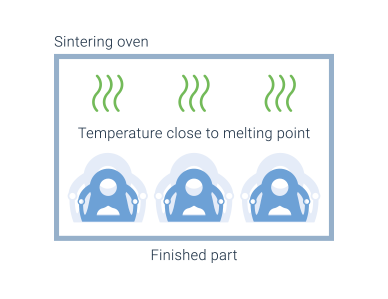
To create a dense metal part the 3D printed green body has to be post-processed in a debinding and sintering process. Similar to the metal injection molding process BJT parts are placed in a high temperature furnace, where the binder is burnt out and the remaining metal particles are sintered together. The sintering results in densification of the 3D printed green body to a metal part with high densities of 97 % to 99,5%, dependent of the material.

Binder Jetting with single print head

In classic Binder Jetting systems such as the ones distributed by EXONE or DIGITAL METAL the liquid binding agent is selectively deposited with a single print head. Meaning the width of the print head does not cover the full width of the powder bed. Therefore, the print head moves multiple times in xy-direction over the powder bed to completely cover the printing area and distributing the polymer binder.

Binder Jetting with single pass jetting

The SINGLE PASS JETTING technology was developed by DESKTOP METAL and HEWLETT PACKARD. The width of the printing head covers the full width of the powder bed. When the printhead passes over the powder bed, binder is released from more than 30,000 small nozzles and the whole powder layer is selectively immersed in binder in one pass. The process is bi-directional which means that the binder deposition takes place in both moving directions of the printhead. With these modifications the printing speed is significantly increased.

A similarly fast technology is the METAL JET process by HEWLETT PACKARD. In a single pass, a liquid printing agent is applied to the powder layer and subsequently partially evaporated to form the binding polymer around the metal powder. After the completion of the print an additional curing to achieve the full green body stability is needed.

Binder Jetting with full layer jetting

3DEO combines the Binder Jetting process with a subsequent machining process. Different from conventional Binder Jetting processes, the binder is not only deposited selectively but onto the entire powder layer. After hardening of the complete layer, the part geometry is shaped through a milling process every couple of layers by cutting the part contour out of the binder powder composite.

Post processing

The basics of debinding and sintering

Due to the low volume of binder in Binder Jetting green parts, the debinding process is usually performed in the sintering oven. For this purpose, the sintering temperature curve will remain at a lower temperature level to evaporate the binder before the temperature is increased to start the sintering phase.

After the binder is removed, the part is sintered to increase strength and structural integrity. The part is heated close to the melting temperature. The temperature is just high enough to initiate a neck formation at the contact points between the metal particles. In the first sintering stage, channels remain between the necks. In the intermediate stage of sintering, the packing density of the part increases and particles merge. In the final stage, the pore size decreases further and the second level binder decomposes completely.

During the sintering process the part shrinks in all directions of about 16 to 20 %. In z-direction shrinkage is larger than the other two directions due to the influence of gravity. Sinter supports used to prevent undesired deformation have to be removed in a subsequent step.

Sintering process

Development history and supply chain

Binder Jetting enables transformation to high throughput

Binder jetting was developed and patented at the Massachusetts Institute of Technology (MIT) in 1993. The machine technology was adapted from normal inkjet printers. The company Z CORPORATION (since 2012 3D SYSTEMS) obtained a license for the process in 1995. In the beginning only polymer powders or sand was used in Binder Jetting processes in order to fabricate prototypes or sandcasting forms. The early adoption of this technology for prototyping applications made Zprinter one of the most popular commercial 3D printer lines available. Later, several companies such as EXONE, HEWLETT PACKARD, DESKTOP METAL, DIGITL METAL and 3DEO obtained licenses and started to develop their own printing systems for metal powders.

EXONE and DIGITAL METAL have been selling metal BJT systems for many years. However, the market penetration of the machines of this technology is very low compared to other processes such as LB-PBF. Since DESKTOP METAL and HP announced their planned entry into the BJT market with newly developed single pass systems and claims of productivity gains of up to 1000x, BJT gained a lot more attention. First single pass commercial systems are available for beta customers since late 2018, early 2019. On this wave of excitement additional machine manufacturers such as GE have been announcing the development of their own BJT printing systems as well.

Technology maturity index

Technology with high expected innovation steps


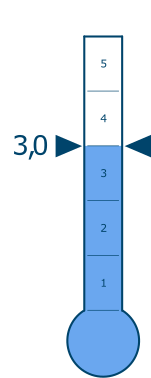
Binder Jetting is still waiting for the wider industrial break through. Although smaller systems from DIGITAL METAL and EXONE are used in first serial production scenarios, the overall installed base of Binder Jetting systems is still very small. However, AMPOWER expects Binder Jetting to quickly rise in the Maturity Index over the next two to three years. Especially the announcements of HP and DESKTOP METAL partnering with major players in the powder metallurgy industry shows, that the bottle neck of the sintering process is targeted and potentially solved soon. The release of large production systems of multiple machine OEMs in 2020 shows, that the target application is beyond the typical PBF part complexity and batch size, but rather trying to cannibalize metal injection molding and powder metallurgy applications.

  • Series production capabiltiy

    High productivity machines installed at beta customers.

  • Process capability

    For specific parts, Binder jetting represents a capable process.

  • Machine concept

    Small off-the shelf machines available, high productivity systems in final development stage.

  • In-process quality control

    The process can be tracked and documented by sensors.

Industrialization index

Binder Jetting still with limited production capacities

  • Technology source

    A number of machine suppliers exist.

  • Installed base

    First Binder jetting systems for industrial use exist.

  • Material availability

    Few material suppliers are known and the range of available alloys is limited to steels and titanium alloys.

  • Experience in the field and documented applications

    Few publications dealing with Binder jetting exist.

  • Knowledge base and consideration in public research

    Few publications available. Public research is starting to grow.

  • Standards and best practices

    First standards and best-practices are in development.

How do we calculate the technology readniess level

AMPOWER has a proprietary system to calculate the technology readiness level of an Additive Manufacturing technology based on two indices. The first index assesses the maturity of a technology (technology maturity index). It is rated by a number between 1 (basic research has been done) and 5 (established full-scale production technology). The second index estimates in how far a technology is established on the market (industrialization maturity index). It is measured on the basis of several weighted parameters. Both indices are important factors for estimation of the success of a technology.

Design and applications

Sintering effects cause design restrictions in Binder Jetting

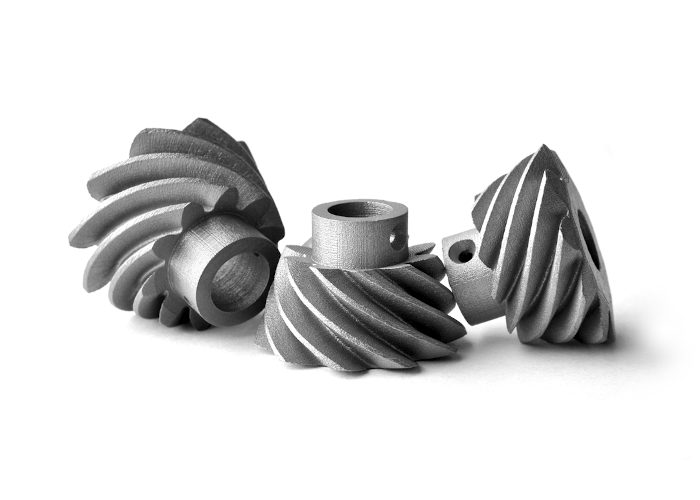
Binder Jetting is especially suited for small part sizes in the range between 5 to 50 mm. Due to the debinding and sintering process and the current state of knowledge, thinner wall thicknesses are preferred. With a surface roughness of about Ra of 5 µm, surface quality is high compared to other metal Additive Manufacturing technologies.

Since the bonding between the polymer ink and metal powder during the 3D printing process takes place without the melting of the metal component, no dimensional distortions occur due to thermal effects. Additionally, the surrounding powder bed supports overhangs and complex geometries. Therefore, no additional support structures are required for the printing process. The dimensional accuracy of printed green bodies is very high.

However, the elevated temperatures and shrinkage during the sintering process require deep knowledge on process specific design. Poorly designed or insufficiently supported green bodies show large distortion and cracking during the sinter process. The shrinkage can be around 20% per direction. While the green body printing process does not require supports, such stabilizing structures are sometimes required for the sintering to avoid undesired deformation.

It is expected that Binder Jetting will replace low volume, high cost metal injection molding parts. These parts typically have applications in automotive, medical or tooling industry. Low volume jewelry and consumer goods are also potential applications for BJT.

  • Typical part sizes

    Typical part sizes range from 5 mm to 50 mm. Large parts cause more complications during debinding and sintering.

  • Resolution

    Layer thicknesses are in a range of 50 µm to 120 µm.

  • Surface roughness

    Parts from Binder Jetting have high surface quality. The surface roughness is in a range of Ra of 3 µm to 5 µm.

  • Wall thickness

    The debinding process is limiting the wall thickness since the debinding time is increasing exponentially with increasing wall thickness. Wall thicknesses of up to 10 mm are recommended.

  • Hollow bodies

    Binder Jetting allows for hollow structures and internal channels. However, sintering can limit those possibilities, if the structure is not stable during the process and needs supports, which need to be removed afterwards.

  • Shrinkage

    The shrinkage of Binder Jetting parts is in the range of 18 % to 21 %. Typically, the z-direction has higher shrinkage due to additional compaction of the part by gravity.

  • Distortion

    Distortion strongly depends on part geometry and support during sintering. Typically, multiple optimization loops to achieve the required final tolerances are needed. After optimization the repeatability of the geometrical deviation is very high.

  • Supports

    No supports are required during the 3D printing process. However, 3D printed supports may improve the sintering process for certain parts.

  • Lattice

    Printing of lattice structures is possible, however lacking stability in green state and distortion during sintering limit size and resolution of lattice structure. Lacking stability of the green body becomes relevant when removing powder cage from the lattice before sintering.

Materials and alloys

Stainless steel standard, many more possible

The only prerequisites of materials for BJT are the sinterability of the alloy and the availability as a powder. Since the manufacturing process does not rely on a welding process such as PBF, many alloy groups with inherent difficulties in AM, such as high carbon steels and carbides, become a possible option for BJT.  However, so far, the most commonly available alloys are stainless steels and tools steels such as 1.4404/316L or 1.4542/17-4 PH. Furthermore, Nickel and Cobalt-based alloys, Copper and titanium alloys are available as well. Cemented carbides are currently under development. Due to general difficulties of sintering aluminum, aluminum and its alloys are not being processed so far. However, the development of aluminum alloys with better sinterability is under development, too.

BJT typically use very fine-grained powder feedstocks with grainsizes from 5 µm to 20 µm. At the moment mainly spherical powders are used, however many system suppliers claim to be able to process non spherical particles. This would significantly drive down the costs of the feedstock in the future.

  • Stainless steel alloys

    Stainless steel is widely available. Most Binder Jetting systems use 316L (1.4404) or 17-4 PH (1.4542).

  • Marging steel

    Marging steels are possible but not yet widely available.

  • Aluminum alloys

    Aluminum alloys are under development.

  • Titanium alloys

    Titanium alloys are available for Binder Jetting.

  • Nickel based alloys

    Nickel based alloys are available for Binder Jetting.

  • Copper

    Copper is available for Binder Jetting.

  • Carbide

    Carbides are under development.

  • Cobalt

    Cobalt alloys are available for Binder Jetting.

  • Magnesium

    Magnesium alloys are currently not available for Binder Jetting.

  • Precious metals

    Precious metals are under development.

Material properties

Binder Jetting comparable to MIM

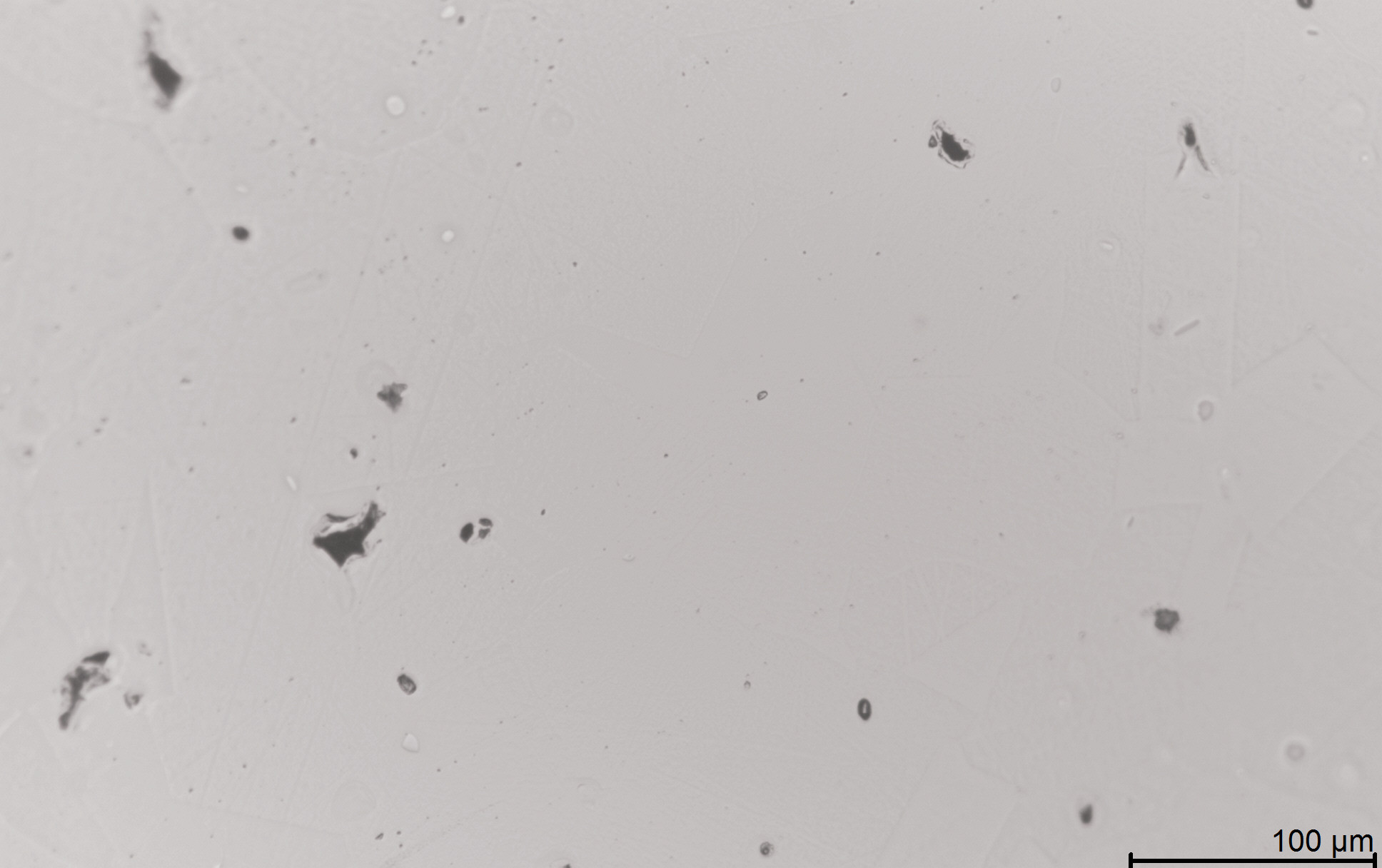
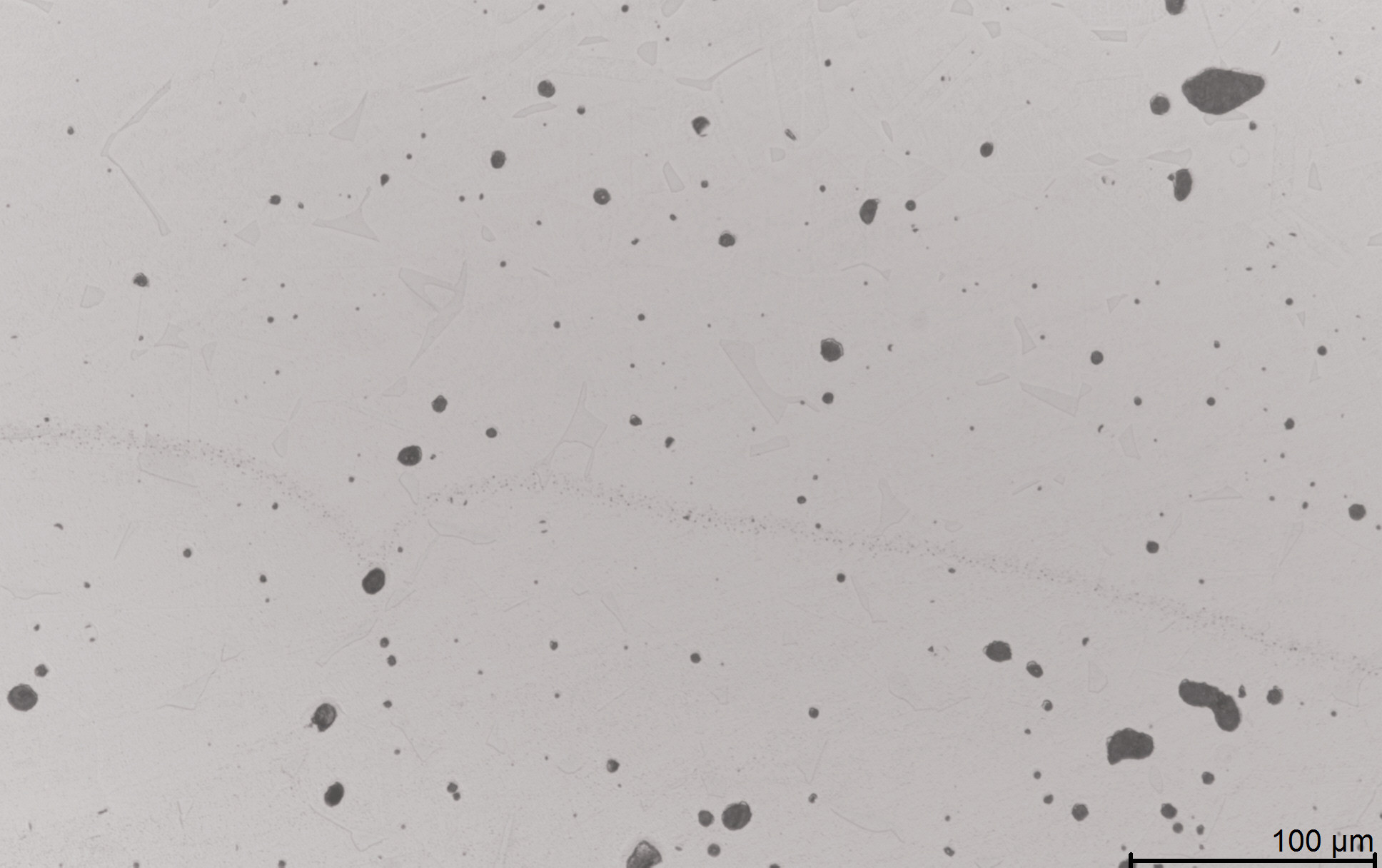
The material properties of parts fabricated by Binder Jetting in 316L excel compared to the values required for steel bars according to ASTM A276 (Standard Specification for Stainless Steel Bars and Shapes). Typically, the material density is around 99 % and therefore compares to high end MIM applications. The pore size and distribution are mainly depending on the debinding and sintering process applied, but typically results in small round pores below 20 µm in diameter. The microstructure shows twinned austenitic grains with grain sizes between 50 to 100 µm. The printed parts exhibit hardness close to the requirements for MIM alloys defined in ISO 22068. Values for yield strength, ultimate tensile strength and elongation exceed the required properties defined for MIM parts in 316L. Fatigue properties of BJT parts is topic of numerous R&D activities, as there is yet little information available.

Typical cross section of Binder Jetting 316L components

1
2
1

Even and round pores typical for sintered materials. Density between 98-99 %. Comparable to high end MIM properties.

2

Larger and uneven pores be due to green part failues

1
1

Typical round gas pores due to sintering.

Typical material properties for Binder Jetting 316L alloy exceed MIM standards

[wpdatachart id=20]

[wpdatachart id=21]

Advantages and disadvantages

Knowledge of sintering process and green part properties drives success of Binder Jetting

  • Low cost

    Especially for build job packing density.

  • High surface quality

    Good surface resolution achievable.

  • Support free

    Green part production with no need of supports.

  • Complex sintering process

    Sintering with many unknown effects and low first time right availability.

  • Powder removal

    High powder density leads to difficult and manual powder removal

  • Little knowledge

    Only little public research. Still high innovation rate.

  • Limited material choice

    Although high variety possible in theory, currently only few alloys available.

Data and sources

Last data update: 26. March 2021

Published: 19. November 2019

Source: AMPOWER

Source ASTM values: ASTM A276 Standard Specification for Stainless Steel Bars and Shapes

Did we miss something?