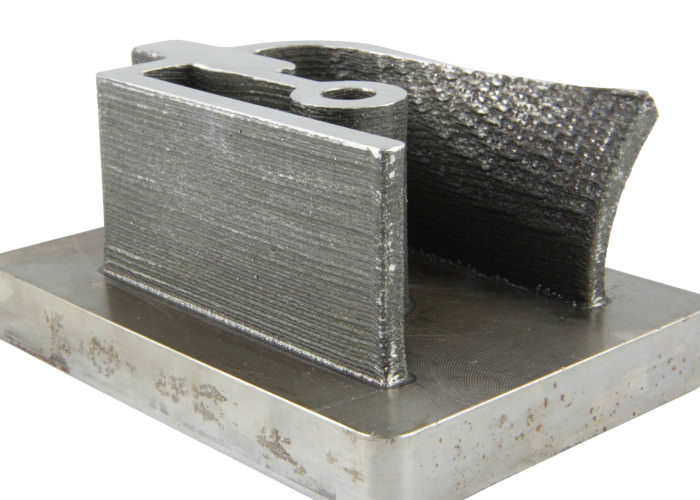
Laser Beam Powder Bed Fusion

Technology deep dive

Laser Beam Powder Bed Fusion

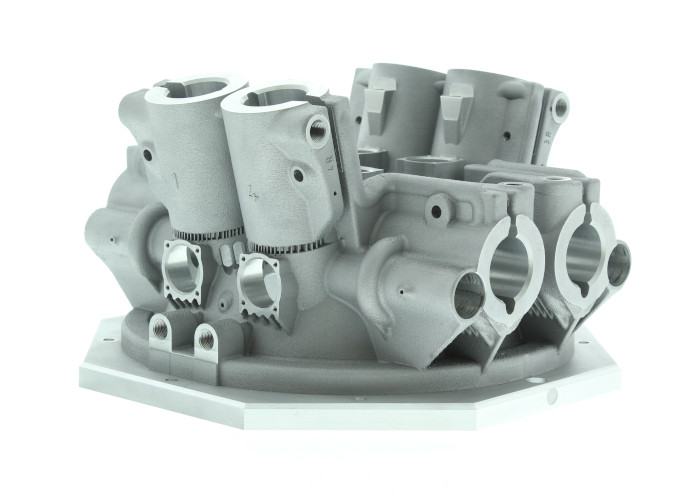
LB-PBF or Laser Beam Powder Bed Fusion, also known as Selective Laser Melting (SLM), is the most known metal Additive Manufacturing technology. With an installed base of several thousand systems, the technology is now widespread and used in many applications in production. This report section gives a broad overview of the state of the art of Laser Beam Powder Bed Fusion.

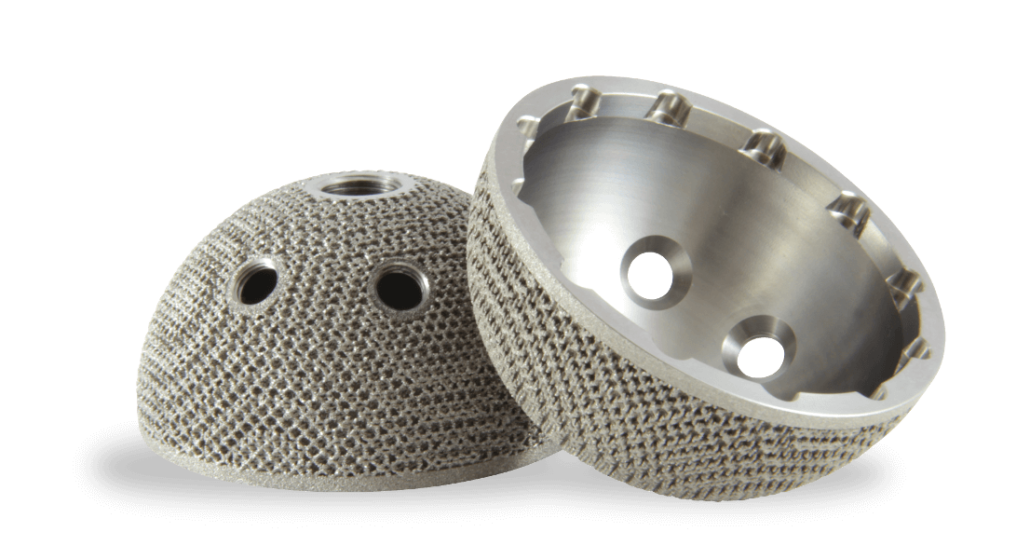
Additive Manufacturing Implant

Technology principle

How does Laser Beam Powder Bed Fusion work?

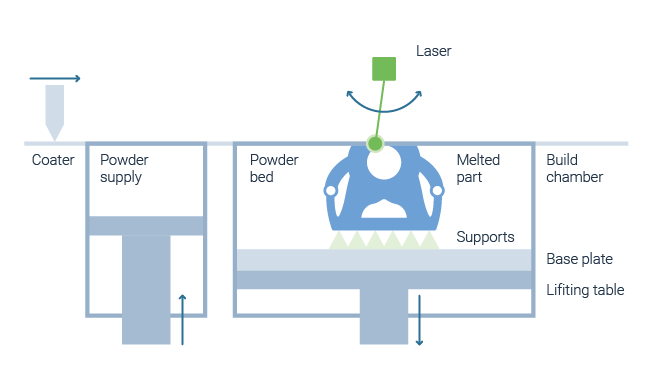
Laser Beam Powder Bed Fusion (LB-PBF) is based on melting of a powder feedstock by exposure with laser radiation. The powder material is applied by a leveling system in a predefined layer thickness to a substrate plate fixed on the build platform. The leveling system can be a blade, brush or roller that applies a predefined amount of powder from a reservoir and spreads it on the substrate plate. Alternatively, the powder container itself is moved across the substrate plate and distributes the powder evenly.

The energy for bonding the powder particles is provided by a laser. The laser beam is directed on the powder bed so that it selectively melts the powder. Machine development started with one laser source and optic, today many production systems use multiple laser to increase productivity.  For guiding the laser beam, often a mirror deflection system is used. Furthermore, machine systems exist in which the laser is moved via a gantry with multiple axes. These solutions promise to be especially cost-efficient.

When the exposure process is completed, the build platform is lowered by the amount of the layer thickness and the next powder layer is applied. When re-exposing the next layer, it fuses with the previously generated layer. The process described is repeated until the entire component geometry is generated. The unexposed powder remains loose and can be recycled.

Because of the strong reaction tendency of metallic powders, the process takes place in protective atmosphere. Before starting the process, the build chamber is purged typically with argon or nitrogen, until an oxygen content of less than 0.1 % is reached. Alternatively, machines exist in which the process takes place under vacuum.

The most important process parameters are the laser power, scanning velocity, the diameter of the laser beam focus and the scan strategy, that defines the pattern in which the powder is exposed. Optimal parameters differ depending on the metal alloy and the powder characteristics.

Laser Beam Powder Bed Fusion with vacuum

To avoid negative effects during the actual fusion process, such as oxygen pickup, usually the build chamber is flooded with a process gas to create an inert atmosphere. Machine suppliers, such as EVOBEAM, offer systems that pull a vacuum inside of the build chamber to create the inert processing atmosphere.

Benefits of using a vacuum as inert atmosphere is use of less costly process gas. Process inherent material porosity in terms of voids can be closed during hot isostatic pressing, since there is no entrapped gas. Furthermore, processing under vacuum may have benefits on the undesired oxygen or nitrogen pickup. Downside of vacuum machines is the complex and usually costly system technology. Also, smoke residue during processing has to be dealt with.

Machine suppliers 3D SYSTEMS and RENISHAW use the evacuation of the build chamber to minimize oxygen contamination before flooding the chamber with Argon gas. The actual melting process in these machines is not run under vacuum, but a highly purified inert gas atmosphere.

Hybrid Laser Beam Powder Bed Fusion

Hybrid LB-PBF systems are a combination of CNC milling and LB-PBF process. Offered by companies OPM LAB and MATSUURA, these machines enable in-situ milling of every other layer contour. After PBF processing of a layer, a milling head inside of the build chamber machines along the contours of the just created part layer to improve its surface quality. Through this strategy, all of the printed part surface can be processed via milling. However, this hybrid processing comes with a loss of productivity of the PBF process. The feasibility is highly part dependent. Today, the systems are almost exclusively used in mold and tool making industry, where a high surface quality is required.

Machine technology

Main machine components of Laser Powder Bed Fusion systems

Basic components of LB-PBF system technology are laser beam source, optical elements for beam shaping and guiding as well as a building chamber with a lifting table and powder feed system.

Almost exclusively, industrial LB-PBF systems today use single-mode fiber lasers of wavelength 1,070 to 1,080 nm. Laser power ranges from 100 to 400 W for smaller LB-PBF systems up to 700 to 1,000 W. Galvanometer scanners deflect the laser beam using rotating mirrors in x- and y-direction. Beam forming is realized through collimation and focusing lenses. Recent trend in machine technology is to move away from f-theta lenses and pre-objective scanning systems towards post-objective setups with dynamic focusing system to avoid process issues from focus shift caused by thermal expansion of lenses.

Multi-laser systems with 2 or more laser beam sources are available for increase of productivity. In such setups, either each laser processes a dedicated area of the build platform or alternative setups allow processing of the full area of the build platform with every laser beam. The second setup simplifies calibration of the of the beam positioning between all lasers and therefore improves quality control issues in the overlap region.

The build chamber is designed gas tight and is flooded with an inert gas such as argon or nitrogen prior to process start. Process smoke and particles are transported away from the fusion process by a directed gas stream within the build chamber and channeled through filtration systems. Variants exist which use a vacuum chamber instead of inert gas atmosphere for protection of the melting process. In general, machines as well as periphery for processing of reactive materials, such as titanium or aluminum alloys, require explosion protection measures.

(Semi-)Automated systems are developed by all major machine manufacturers to improve productivity and hence industrial applicability. ADDITIVE INDUSTRIES provides modules for automated build platform setup, unpacking and heat treatment handling.

Development history

How Laser Beam Powder Bed Fusion became the leading metal technology

A preliminary stage of LB-PBF technology was the so-called Selective Laser Sintering (SLS), that was developed in 1988. Three dimensional objects were built layer-wise from CAD data with polymer powders. Later, the process was extended to the manufacture of metal parts by using polymer coated metal powders. In 1994, a process branded Direct Metal Laser Sintering (DMLS) was established by EOS. It allowed a direct one-step manufacturing of metal parts by using two-phase powder in a liquid-phase sintering process. In this process a low temperature melting component was mixed with higher temperature resistance powders. When exposed by the laser beam only the low melting component melted and formed a matrix around the remaining powder particles.

Since two-phase powder materials still did not match the properties of engineering materials, extensive research was done mainly at German universities to qualify single-phase powders for the DMLS process. Simultaneously, the machine technology was further developed at German system suppliers (CONCEPT LASER, EOS, SLM SOLUTIONS). Another machine system derived from the early principle was brought onto the market in 2003 by TRUMPF under the brand name of Direct Laser Forming (DLF). However, TRUMPF withdrew from the market after a short time due to the immaturity of the market and therefore limited sales potential.

Until 2010 the main development focus in universities and at the machine suppliers was on stabilizing the melting process. Due to many patents expiring in 2010 new players entered the market and could secure shares. With the Additive Manufacturing hype starting in 2013, the technology got a lot of attention and machine sales increased significantly. Within the last few years many new suppliers for LB-PBF machines emerged utilizing lower cost components, unique scanning strategies and copying established systems. Additionally, large cooperation’s entered the market by buying smaller machine manufacturers. Today over 60 LB-PBF machine supplier are active in the market.

Supply Chain

LB-PBF supply chain diversifies from machine OEMs

Historically, powder material was provided by the machine suppliers. Today, users are able to acquire suitable metal powders directly from material suppliers. Large powder suppliers from PM technologies as well as small AM specialized start-ups entered the AM powder market and today Ampower counts over 55 suppliers offering AM specific powder material in a large variety of alloys. A similar trend can be seen for machine technology. More peripheral devices, especially for powder handling, are introduced into the market by independent suppliers.

Software solutions for orientation and positioning of parts on the built platform and simulation of internal stresses are available from machine suppliers and directly from independent developers. The established CAD-CAM software houses are working on integrated software solutions with AM specific modules.

Technology maturity index

A technology on the brink of full maturity

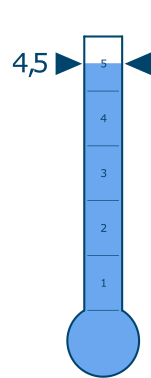
Laser Beam Powder Bed Fusion has established itself as the leading AM technology for metal applications. The use of LB-PBF for the production of end parts in highly demanding industries such as medical, aviation and the energy sector has driven a continuous improvement of machine hardware and process reliability over the past five years. Large efforts by all major machine OEMs were taken to optimize and stabilize the gas flow, enable an easy-to-use calibration of multi-laser systems and establish an overall improvement of machine reliability. Due to these developments across all major machine OEMs, the part quality and consistency has significantly improved with the newly released LB-PBF system generation. Consequently, LB-PBF has reached the top right corner of the AMPOWER Maturity Index. Additionally, to these urgently needed improvements in machine reliability and process repeatability, to meet industrial standards and expectations, more recent developments in LB-PBF have been focusing to further increase the production speed and integration of LB-PBF in a conventional industrial set-up.

To increase production speed and reduce part cost multi-laser machines were introduced into the market nearly a decade ago. By now, most OEMs offer machines with up to 4 lasers working in parallel on the powder bed. To push production speeds even further SLM SOLUTIONS, the pioneer of multi-laser machine set-ups, introduced its newest 12-laser machine in 2020. Additionally, VELO3D announced an 8-laser system to be available in 2021 and 3D Systems partners with the US Army Research Lab to develop “the world’s largest and fastest printer”.

Accompanying the trend of higher productivity of the melting process are the general efforts to industrialize the whole digital and physical process chain. The aim is to leave the stand-alone machine set-ups and software solutions behind and integrate the LB-PBF process into industrial set-ups known from conventional manufacturing technologies. The newest machine generations are equipped with APIs to connect them to the customers MES and ERP systems to efficiently collect process information for KPI analysis. Parallel to the developments of machine analytics software from the OEMs, all major software providers are working on AM specific solutions to further integrate the machines into the customers CAD/CAM and resource planning tools. Additionally, to the industrialization of the digital process chain, the LB-PBF OEMs are working on factory set-ups connecting multiple machines among each other and with essential post-processing steps such as unpacking, heat treatment and separation from base plate. ADDITIVE INDUSTRIES already integrates the “whole” process chain into its MetalFAB1, while 3D SYSTEMS, EOS, GE ADDITIVE and SLM SOLUTIONS have presented concepts on how to connect single process steps to an automated process chain.

  • Series production capabiltiy

    LB-PBF technology is used in production environment across multiple verticals, a dedicated periphery exists.

  • Process capability

    Defects only occur occasionally, and repeatability and reproducibility are high.

  • Machine concept

    Machine concepts are mature and both standard machines as well as customized machine technology is available. For example, to meet customer demands machines with larger build volume can be specifically designed and provided.

  • In-process quality control

    Inline-process sensors can be applied. Tools for prediction of internal stresses exist.

Industrialization index

Wide adoption through all high value metal verticals

  • Technology source

    More than 40 suppliers for LB-PBF technology are known worldwide that lead to a competitive market.

  • Installed base

    LB-PBF technology has a large installed base and penetrates all kinds of industries.

  • Material availability

    There are multiple material suppliers and many technically relevant alloys are available.

  • Experience in the field and documented applications

    LB-PBF is used in serial production across multiple verticals.

  • Knowledge base and consideration in public research

    High knowledge base and dedicated research programs exist.

  • Standards and best practices

    Industry specific standards exist.

How do we calculate the technology readniess level

AMPOWER has a proprietary system to calculate the technology readiness level of an Additive Manufacturing technology based on two indices. The first index assesses the maturity of a technology (technology maturity index). It is rated by a number between 1 (basic research has been done) and 5 (established full-scale production technology). The second index estimates in how far a technology is established on the market (industrialization maturity index). It is measured on the basis of several weighted parameters. Both indices are important factors for estimation of the success of a technology.

Design and applications

High design freedom only limited by support structures

Regarding the design of parts fabricated with LB-PBF technology, several principles have to be considered. Overhanging structures must be braced by support structures to enable heat dissipation and to avoid part deformations due to internal stresses.

Horizontal holes or channels have to be supported, too, or designed in a drop shape to avoid overhangs. Minimal wall-thickness depends on the optical resolution of the machine and parameter set. In general, a wall-thickness of more than 0,5 mm is recommended.

Theoretically, the maximum part size depends only on the build volume of the machines and is in the range of several decimeters in all directions. In practice, process stability and resulting residual stresses in massive metal parts have to be considered and may limit the component size.

  • Typical part sizes

    Typical part sizes range from 15 mm to 300 mm. Large parts can cause complications due to distortion.

  • Resolution

    Layer thicknesses are in a range of 0.025 – 0.06 mm.

  • Surface roughness

    The surface roughness depends on the layer thickness and the material. Typical Ra values are between 5 – 10 µm.

  • Wall thickness

    Thick walls can cause porosity. Typically walls between 1 – 10 mm are recommended. Sudden jumps in thickness should be avoided.

  • Hollow bodies

    Hollow bodies are possible as long as the support material and residual powder can be removed.

  • Shrinkage

    There is not shrinkage that has to be considered.

  • Distortion

    Residual stresses can cause distortion. Especially for overhangs and large parts, distortion can be a problem. Advanced simulation tools are available.

  • Supports

    Usually overhangs of 45° can be build support free. In some cases, process modifications allow for even lower overhangs up to 10°.

  • Lattice

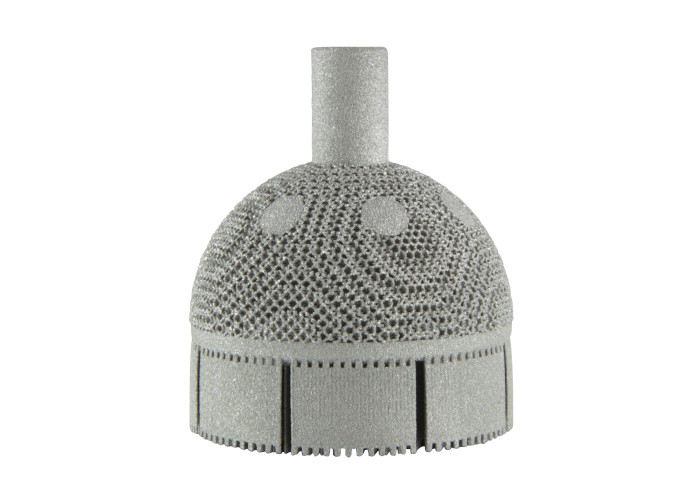
    Lattice structures are possible and easy to achieve with LB-PBF.

Materials and alloys

Laser Beam Powder Bed Fusion material variety

For LB-PBF a large variety of alloys is commercially available. The most important prerequisite is a good weldability. Furthermore, the material must be available as a powder with a suitable particle size distribution. The powder fraction is system and process specific and differs between about 20 µm to 60 µm. With an adaptation of process parameters larger as well as finer powder fractions are possible, too. Very fine powder fractions tend to agglomerate during handling and coating due to extremely fine dust particles in the distribution and should be avoided.

Typical alloys processed with LB-PBF are Ti-6Al-4V, CoCr, stainless and tool steels, nickel-based superalloys, aluminum alloys and also precious metals. High purity copper is difficult in processing with today’s machine systems as the available laser wave lengths is only poorly absorbed.

  • Stainless steel alloys

    Stainless steel is widely available.

  • Maraging steel

    Maraging steels are possible with LB-PBF.

  • Aluminum alloys

    Aluminum alloys are possible and available. High strength aluminum alloys are not yet possible due to cracking.

  • Titanium alloys

    Titanium alloys are available for LB-PBF.

  • Nickel based alloys

    Nickel based alloys are available for LB-PBF.

  • Carbide

    Carbides are challenging for LB-PBF and currently not available.

  • Copper and bronze

    Copper is possible under process or alloy modifications, such as a green laser.

  • Cobalt

    Cobalt alloys are available for LB-PBF.

  • Magnesium

    Magnesium has been processed in R&D environment but is not commercially available.

  • Precious metals

    Some precious metals like platinum or gold are available for LB-PBF.

Material properties

Laser Beam Powder Bed Fusion with high material properties

Parts fabricated with LB-PBF technology exhibit similar properties as parts fabricated with conventional methods. Parts usually far exceed a density of 99.7 %. However, the surface is rather rough due to staircase effects or adhering powder particles. Functional surfaces typically require post processing to decrease surface roughness.

Due to high temperature gradients during cooling a fine-grained microstructure is the result in the part. In comparison to conventional material properties, LB-PBF exhibits in general static mechanical properties with very high strength. A brittle behavior with relatively low elongation at break may be observed. Using common heat treatments, the material properties can be influenced as desired.

Fatigue resistance is highly dependent on surface quality, i.e. surface defects, and residual porosity. Parts exhibit good fatigue strength, if post processing achieved high surface quality and residual porosity was reduced through hot isostatic pressing.

1
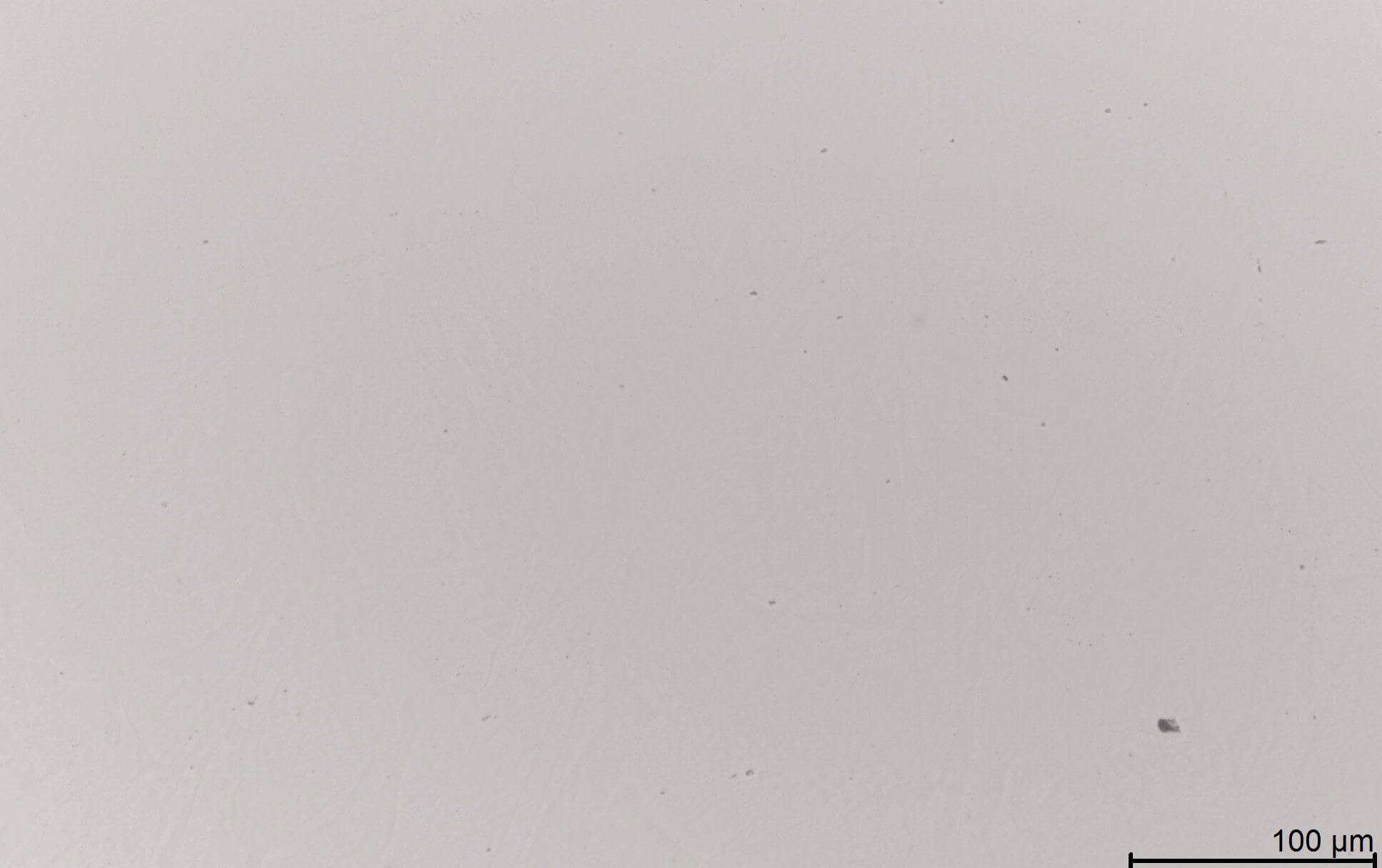
Laser beam powder bed fusion cross section
1

Very few defects with laser beam powder bed fusion. Typically densities over 99,6 % can be achieved.

Typical cross section of Laser Beam Powder Bed Fusion components

Typical material properties for LB-PBF exceed ISO standard for surgical implants

[wpdatachart id=18]

[wpdatachart id=19]

Advantages and disadvantages

Cost as the remaining threshold for a wider adoption

The main benefits of LB-PBF technology are the good mechanical properties of the resulting parts, their high density and the fine resolution. The technology is well-established with a large variety of available metal alloys. It is a single-stage production that enables a high freedom of design. Scrap material is reduced through near net shape production and recycling of the unmelted powder.

However, internal residual stresses that are induced during cooling constitute a restriction since they can lead to part deformations or cracks. Support structures to counteract such stresses have to be removed after the building process. The relatively rough surface, moreover, typically requires several post-processing steps. The investment costs for machine systems as well as the feedstock material are considerably high and may pose a limiting factor on potential business cases.

  • Knowledgebase

    Public knowledge widely available through universities and industry.

  • Mature system technology

    Systems with high stability and availability.

  • Wide material range

    Constantly growing material base and many options for individual alloy development.

  • Established supply chain

    Broad network of service, material and system suppliers.

  • Superior material properties

    High achievable surface quality and material properties.

  • High cost

    High material requirements and slow build rates at high system invest lead to overall high cost.

  • High complexity

    Although the knowledge base is growing, high complexity for process, material and system remains.

Data and sources

Last data update: 26 March 2021

Published: 19 November 2019

Source: AMPOWER

Source ISO: ISO 5832-3:2016 Implants for surgery — Metallic materials — Part 3: Wrought titanium 6-aluminium 4-vanadium alloy

Did we miss something?